GRPO
Outcome only
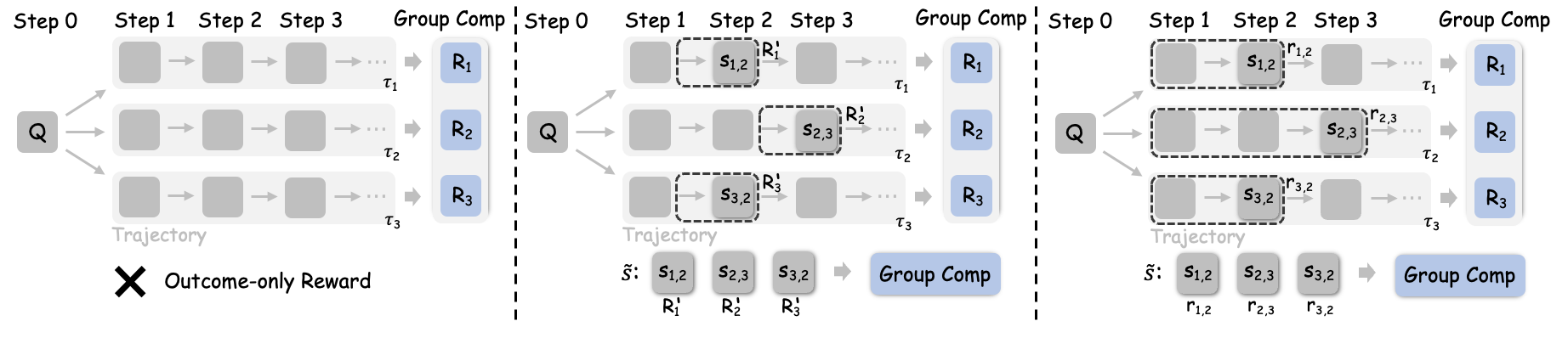
One terminal reward is broadcast to every action, so useful, redundant and harmful searches look alike.

EMNLP 2026 · Main Conference
Knowledge-Grouped Policy Optimization for Search Agents
1Zhejiang University2Tencent†Corresponding author
The idea
Deep search agents issue long chains of queries, read noisy pages and decide when to stop. Outcome-only RL gives every step the same terminal reward. Step-level methods try to do better, but they either match trajectories by surface states, which rarely recur when every rollout reads different pages, or use the model's own answer probability, which long and noisy contexts can bias. KnowGPO anchors credit to something checkable: the set of atomic facts a trajectory has verifiably acquired so far.
GRPO
One terminal reward is broadcast to every action, so useful, redundant and harmful searches look alike.
GiGPO
Steps are compared only when their environment states match, and heterogeneous search observations leave most steps without a partner.
KnowGPO
Steps that start from the same verified knowledge are compared, and each step's reward is the number of new conditions it satisfies.
Method
The walkthrough below uses a query from the paper's case study (Appendix G). The condition set, the three rollouts and their numbers are illustrative, chosen to show the mechanics; the advantages are computed exactly as in Eqs. 4–8 with ω = 0.3.
Query Q
In Emily Midkiff's June 2014 article in a journal named for one of Hreidmar's sons that guarded his house, what word was quoted from two different authors in distaste for the nature of dragon depictions?
Reference answer y* fluffy
Stage 1 · reasoning skeleton query only, placeholders for unknown entities
<E1> is a son of Hreidmar who guarded his house.<E2> appeared in a journal named after <E1>.<E2> quotes two authors, <E3> and <E4>, on dragons.<E3> and <E4> both use the word <E0> in distaste.Stage 2 · grounding with y* and one successful trajectory
<E0>fluffy<E1>Fafnir<E2>“Dragons are Tricksy”<E3>Ruth Stein (1968)<E4>Margaret Blount (1974)K(Q): atomic, complete, consistently grounded
LLM verifier checks each step against K(Q):
si,t = si,t−1 ∨ Δsi,t
monotone: acquired knowledge is never lost
condition not yet verified verified (k1 … k4, left to right) +1gain ri,t = ‖si,t‖₁ − ‖si,t−1‖₁
Observation anchor retrieved-text similarity ≥ 0.9, as in GiGPO
The only match pairs an exploration step with a later one, while the other 7 steps stay singletons: 2 / 9 steps can be compared, and that comparison is misaligned.
Knowledge anchor exact equality of the prior state si,t−1
8 / 9 steps share a group with another step. Over 55,571 real steps the paper measures an effective step ratio of 97.8% for knowledge states vs 51.8% for observations.
Step level gain normalised within its group: AS = (r − μs̃) / (σs̃ + ε)
Episode level outcome normalised across the N rollouts, as in GRPO
Mix Ai,t = (1 − ω)·AEi + ω·ASi,t, ω = 0.3
01
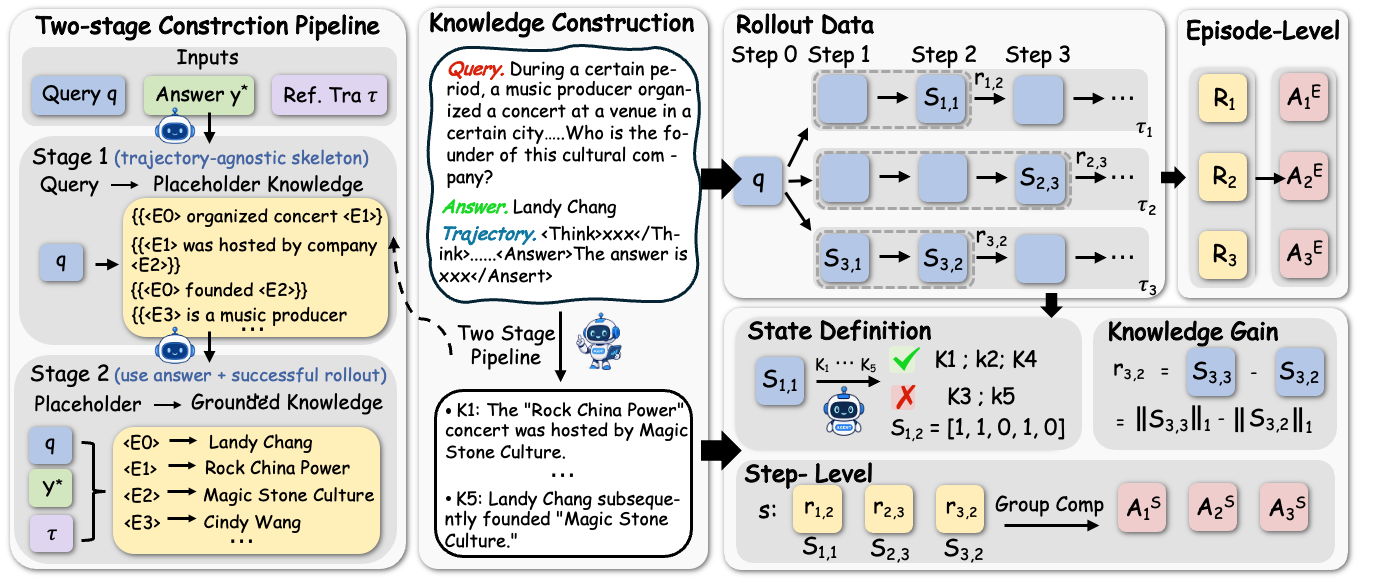
For each query, K(Q) = {k1, …, kK} lists single-hop facts needed to derive y*. Stage 1 reads only the query and writes a reasoning skeleton with entity placeholders (<E0> is the answer); Stage 2 grounds each placeholder using the answer and a successful reference trajectory. The result is atomic, complete and consistently grounded, and its condition–entity graph must be connected from <E0>.
02
At every step an LLM verifier marks which conditions the history now supports, Δsi,t ∈ {0,1}K. The state accumulates by element-wise OR, si,t = si,t−1 ∨ Δsi,t, so knowledge cannot be unlearned and transient verifier noise is absorbed. Two steps with the same state have acquired the same facts, whatever they searched or read.
03
Non-terminal steps with the same prior state form a group G(s̃). The step reward is the incremental gain ri,t = ‖si,t‖₁ − ‖si,t−1‖₁, normalised within the group into AS. It is mixed with the episode-level GRPO advantage AE as (1 − ω)AE + ωAS and optimised with a PPO-style clipped objective. No critic, no observation matching, no model confidence.
Results
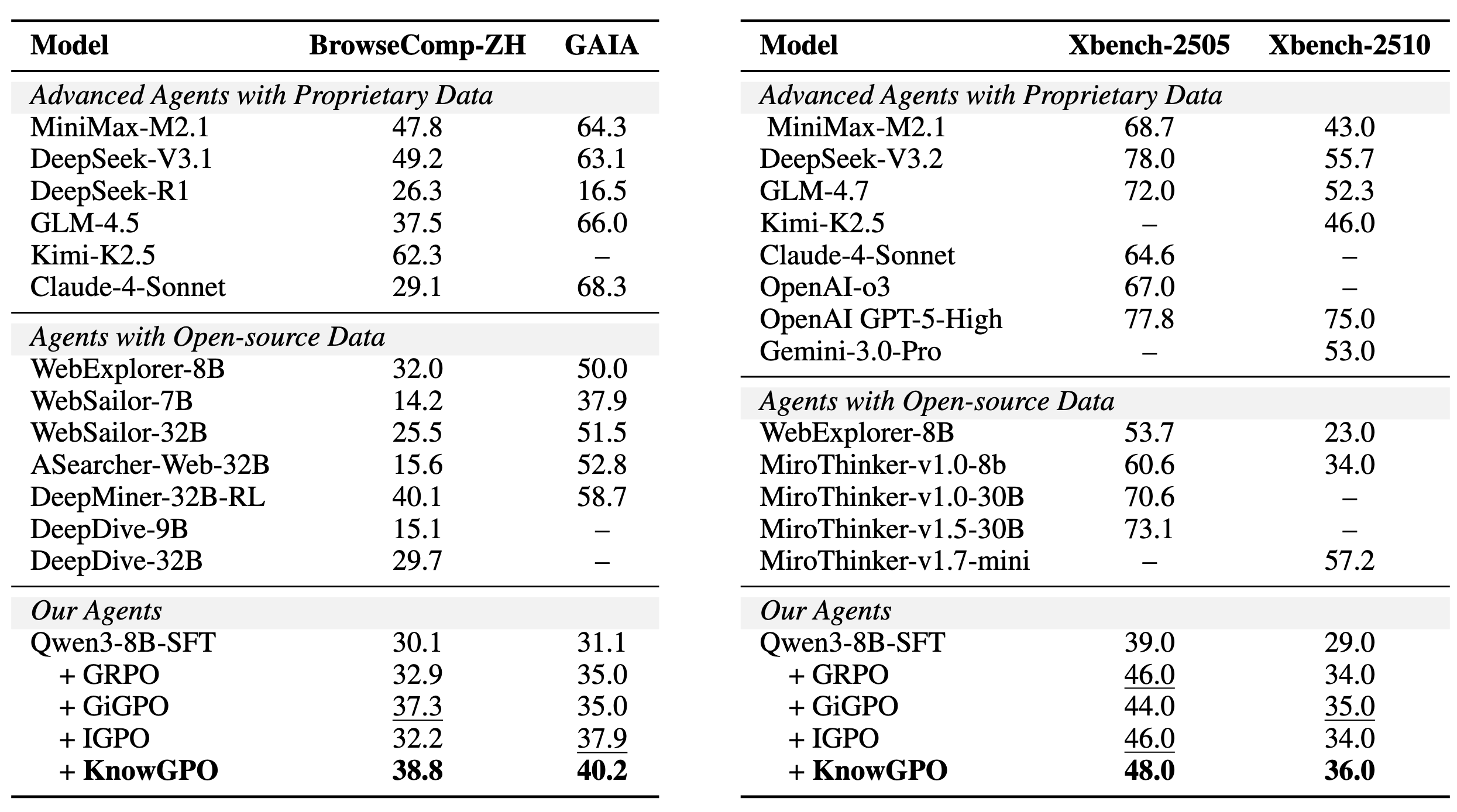
All RL methods start from the same Qwen3-8B SFT checkpoint with identical data, tools and rollout settings; only the advantage estimator and reward design differ. Scores are accuracy (%) judged by GPT-4o, averaged over 3 runs.
Reference agents use different training data, context lengths and tool stacks, so they are context rather than a controlled comparison. Scale: 0–80%.
| Setting | Xbench-2505 | Xbench-2510 | BrowseComp-ZH | GAIA |
|---|
Analysis
The paper samples 500 queries from Xbench and BrowseComp, rolls out the SFT checkpoint up to 16 times each and groups the resulting 5,922 trajectories (55,571 steps) with three anchors.
BGE-large similarity of retrieved content ≥ 0.9
similarity of generated search queries
exact equality of accumulated state (ours)
Cross-rollout coverage stays close to the highest value, so the alignment comes from matching steps across independent trajectories rather than merging neighbouring steps of one rollout. In a case from Appendix D, two steps whose retrieved content has cosine similarity 0.987 are grouped by the observation anchor, yet one has acquired none of the 12 conditions and the other most of them; the knowledge anchor keeps them apart.
Average search turns on 500 test queries, split by which method solves them.
| Subset | Queries | GRPO | KnowGPO |
|---|---|---|---|
| KnowGPO only | 127 | 11.55 | 9.83 |
| GRPO only | 89 | 9.51 | 10.36 |
| Both pass | 103 | 7.03 | 6.33 |
| Both fail | 181 | 11.39 | 10.85 |
KnowGPO stops early when evidence suffices and keeps searching on hard queries. In the paper's case study, GRPO finds “fluffy” by step 8, searches four more turns and overwrites it with “softened”.
Five candidate verifiers on 200 manually annotated query–trajectory pairs.
| Verifier | Regression ↓ | Parse ↑ | Agreement ↑ |
|---|---|---|---|
| DeepSeek-v3.2 | 0.052 | 0.987 | 0.947 |
| Gemini-2.5-Flash-Lite | 0.057 | 0.971 | 0.746 |
| DeepSeek-v3.1-Terminus | 0.057 | 0.924 | 0.835 |
| DeepSeek-v3.1 | 0.052 | 0.921 | 0.911 |
| GPT-4o-mini | 0.065 | 0.896 | 0.614 |
Regression counts monotonicity violations. DeepSeek-v3.2 is used as the verifier throughout.
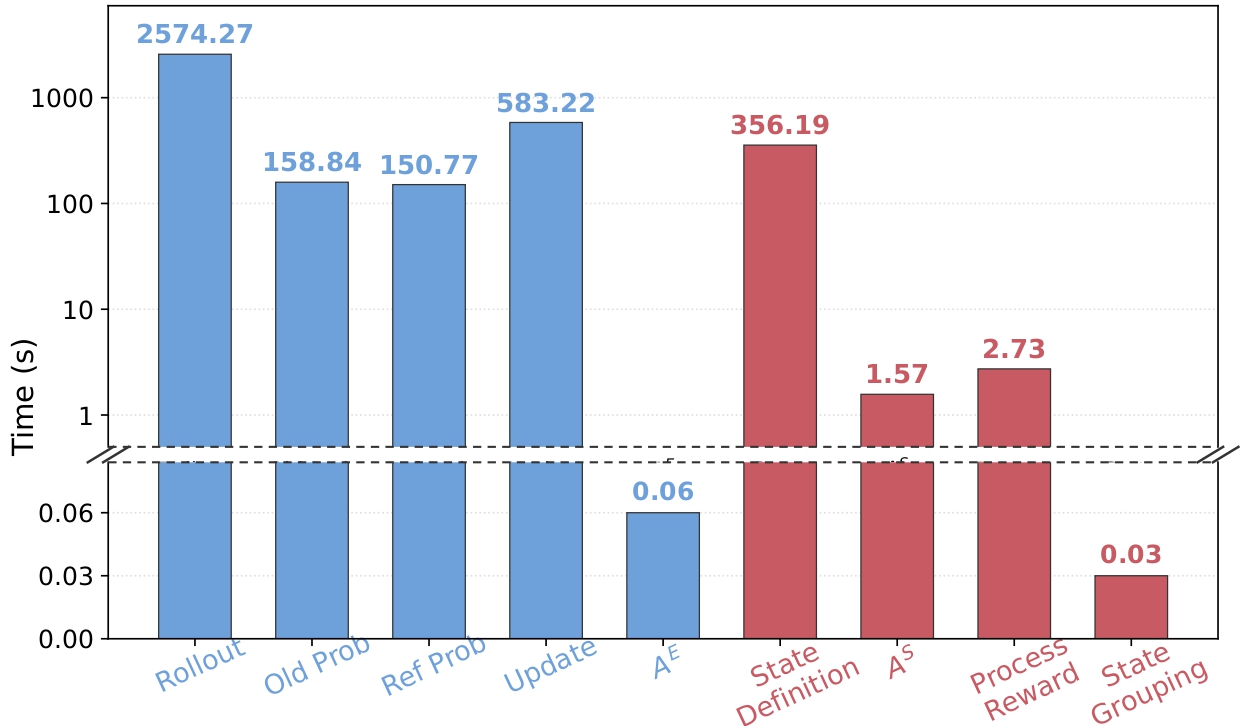
Per-iteration time on 64×H20 is dominated by operations shared with GRPO: rollout (2,574 s), policy update (583 s) and probability computation (310 s). Knowledge verification (356 s) runs asynchronously and overlaps with the next rollout. Incremental gain (2.73 s) and group construction (0.03 s) together take less than 0.08% of the budget.
Takeaways
Code: github.com/ZJU-REAL/KnowGPO. The repository notes that the training code release is coming soon. Training builds on veRL.
Citation
@article{chen2026knowgpo,
  title   = {KnowGPO: Knowledge-Grouped Policy Optimization for Search Agents},
  author  = {Chen, Siqi and Lu, Zhengxi and Yan, Yuchen and Wu, Xingyu and Chen, Qipeng and Zhang, Xin and Liu, Aiting and Deng, Chao and Liu, Jie and Ma, Jin and Lu, Weiming and Xiao, Jun and Shen, Yongliang},
  journal = {arXiv preprint arXiv:2610.22331},
  year    = {2026}
}