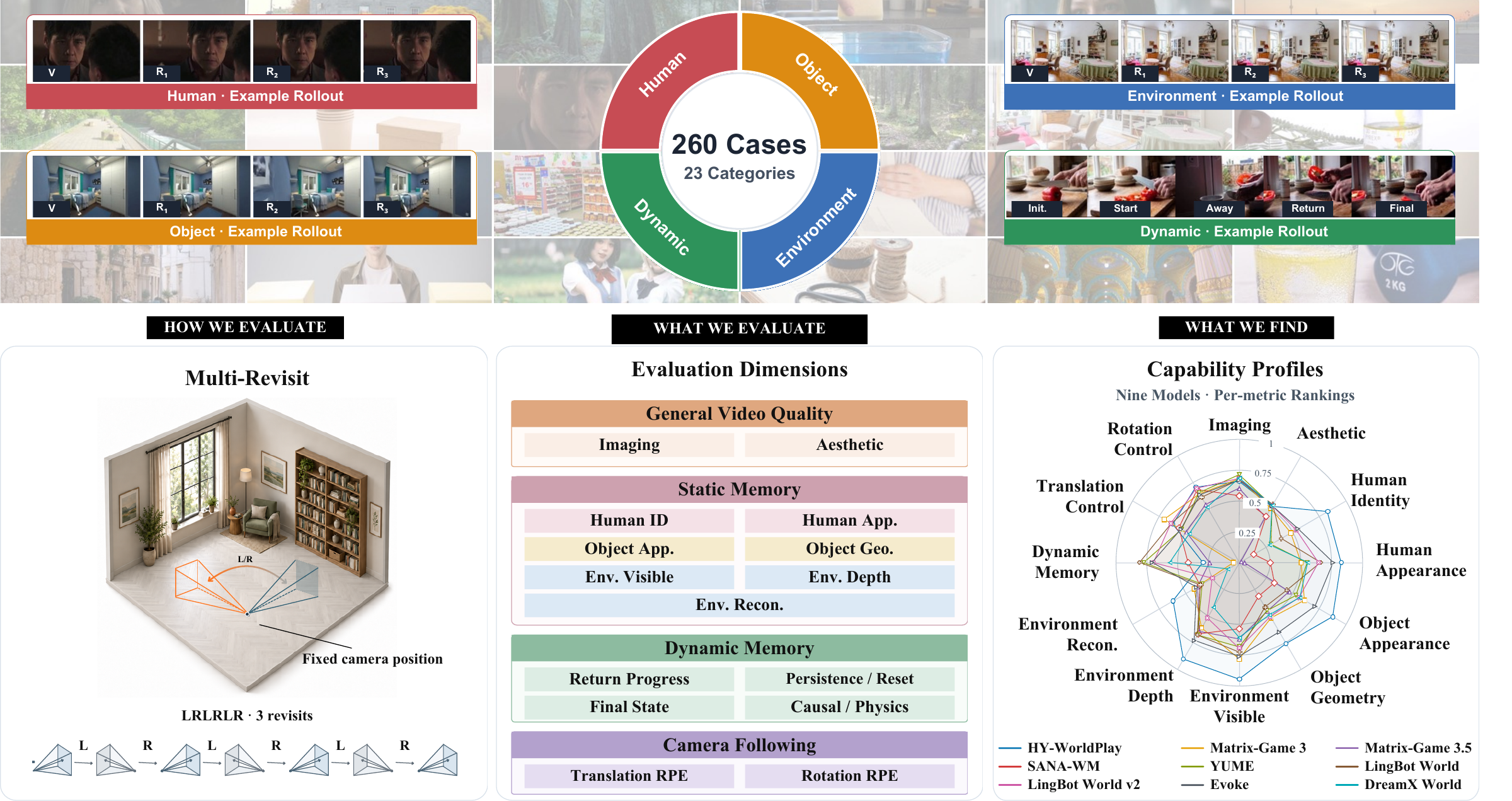
A benchmark for world memory
We introduce WorldMemBench, a comprehensive benchmark for the structured evaluation of memory capabilities in video world models.
A Comprehensive Benchmark for Memory of Video World Models
1 Zhejiang University 2 Fudan University 3 Ant Group 4 Nanjing University
We introduce WorldMemBench, a comprehensive benchmark for the structured evaluation of memory capabilities in video world models.
We develop a multi-revisit evaluation protocol to assess static and dynamic memory alongside camera controllability.
We evaluate nine video world models, revealing distinct memory profiles, cumulative degradation across revisits, and sensitivity to exploration direction and context access.
We evaluate nine representative video world models across General Video Quality, Static Memory, Dynamic Memory, and Camera Following. The table reports aggregate results from the paper, including four Dynamic Memory sub-metrics.
Three matched cases across nine models compare the initial view (V) with three successive returns (R1–R3). Select a case, return, and models; each score summarizes one revisit segment.
| Benchmark | Input | Length (s) | Camera control | Visual quality | Long-horizon revisit | State evolution | Physical consistency | Multi- revisit |
|---|---|---|---|---|---|---|---|---|
| WorldScore | C·L | ~2–10 | ✓ | ✓ | — | — | — | — |
| MIND | A | ~5–10 | ✓ | ✓ | ◐ | — | — | — |
| WorldMark | C·A·L | 20–60 | ✓ | ✓ | ✓ | — | — | — |
| WBench | C·A·L | ~10–45 | ✓ | ✓ | ✓ | ◐ | ◐ | — |
| MBench | C·A·L | ~25 | ✓ | — | ✓ | ✓ | ✓ | — |
| MemoBench | C·A·L | ~4–6 | ✓ | ✓ | — | ✓ | ✓ | — |
| WorldRoamBench | C·A·L | 10–60 | ✓ | ✓ | ✓ | ◐ | ◐ | — |
| WorldExam | C·A·L | ~3–12 | ✓ | ✓ | ◐ | ◐ | ◐ | — |
| R2M-Bench | C·A | ~30 | — | — | ✓ | — | — | — |
| STEVO-Bench | C·L | ~5–30 | — | — | ◐ | ✓ | ✓ | — |
| WRBench | C·A·L | ~4–10 | ✓ | — | ◐ | ✓ | ◐ | — |
| LoopBench | C·A | ~3–24 | — | — | ◐ | — | — | ✓ |
| WorldMemBench | C·A·L | ~20–35 | ✓ | ✓ | ✓ | ✓ | ✓ | ✓ |
If you find WorldMemBench useful for your research, please consider citing our paper.
@misc{zhou2026worldmembenchcomprehensivebenchmarkmemory,
  title={WorldMemBench: A Comprehensive Benchmark for Memory of Video World Models},
  author={Nan Zhou and Jianxiong Gao and Qiuyu Wang and Wen Wang and
          Jiahao Wang and Yufeng Yuan and Shuaiting Li and Hao Ouyang and
          Yujun Shen and Weiming Lu and Jun Xiao and Yueting Zhuang and
          Yongliang Shen},
  year={2026},
  eprint={2610.19063},
  archivePrefix={arXiv},
  primaryClass={cs.CV},
  url={https://arxiv.org/abs/2610.19063},
}